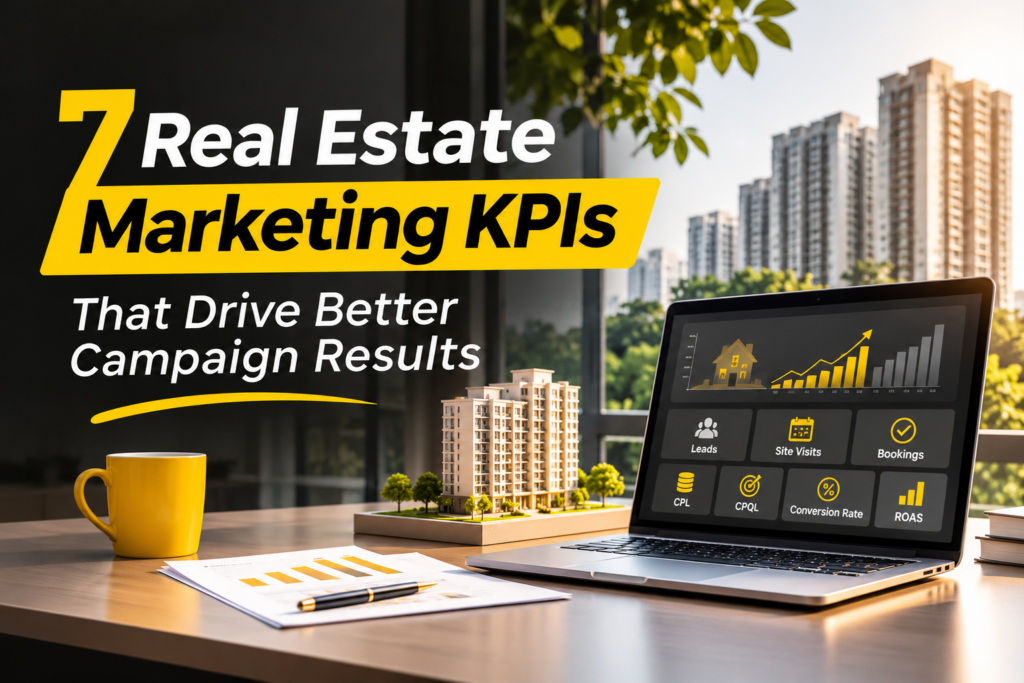

Real Estate KPIs play an important role in measuring digital marketing performance. Developers use Facebook Ads, Instagram Ads and Google Ads to attract potential buyers. However, generating enquiries is only the first step. They must also track lead quality, site visits and bookings to understand campaign results.
For example, a campaign may bring 200 leads at a low cost. However, most of them may not be interested in the project. This means the campaign is getting enquiries but may not be bringing real buyers.
That is why developers need to track the right marketing KPIs. These numbers show which campaigns are working and which need changes.
This article explains seven important real estate marketing KPIs. They help developers measure lead quality, site visits, bookings and ad results.
Why Are Marketing KPIs Important for Real Estate Developers?
Real estate marketing has many stages. First, developers build awareness about their projects. Next, they attract enquiries from potential buyers. After that, sales teams follow up and try to arrange site visits.
However, not every enquiry becomes a site visit. Similarly, not every site visit leads to a booking.
This is where marketing KPIs help. They show how people move from one stage to the next. They also help answer important questions:
- How much does it cost to get one enquiry?
- How many enquiries match the project’s target audience?
- How much does it cost to get one qualified lead?
- How many potential buyers complete a site visit?
- How many site visits turn into bookings?
- How much revenue is linked to advertising?
By checking these numbers, developers can understand more than just the number of leads. They can also find gaps in their campaigns and improve their marketing plans.
1. Cost Per Lead (CPL)
Cost Per Lead is one of the most common metrics in real estate advertising.
It tells developers how much they spend to get one enquiry.
For example, a project spends ₹50,000 on ads and gets 100 leads. The Cost Per Lead is ₹500.
Formula:
Cost Per Lead = Total Advertising Spend ÷ Total Leads Generated
Why Does CPL Matter?
CPL helps developers understand the cost of getting enquiries from their ads.
It also makes it easier to compare different platforms, audiences and ad creatives. For example, developers can check whether Facebook Ads or Google Ads are bringing leads at a lower cost.
However, a low CPL does not always mean a campaign is doing well. Some ads may bring cheap leads from people who are not interested in the project. As a result, the sales team may waste time following up with unsuitable prospects.
What Should Developers Monitor?
- CPL across different advertising platforms.
- CPL for each real estate project.
- Results from individual ad campaigns.
- Changes in CPL over time.
- The connection between CPL and lead quality.
The goal should not be to get the cheapest leads. Instead, developers should focus on getting relevant enquiries at a reasonable cost.
2. Lead Qualification Rate
Getting enquiries is important. However, not every person who fills out a form is a potential buyer.
Lead Qualification Rate shows how many enquiries match the project’s basic buyer requirements. These may include budget, location and property preferences.
For example, a project receives 200 enquiries. The sales team checks them and finds that 60 people match the project’s requirements.
This means the Lead Qualification Rate is 30%.
Formula:
Lead Qualification Rate = (Qualified Leads ÷ Total Leads) × 100
Why Does It Matter?
This metric shows whether ads are reaching the right people.
For example, a campaign may generate many enquiries. However, only a few may match the project’s target audience. In that case, the campaign may need better targeting or a clearer message.
What Should Developers Monitor?
- Number of qualified and unqualified enquiries.
- Common reasons for rejecting leads.
- Audiences that bring relevant enquiries.
- Lead quality across different campaigns.
- Feedback from the sales team.
By checking this rate, marketing teams can see what needs to improve. For example, they can target better audiences and create clearer ad messages. As a result, their campaigns can attract more relevant buyers.
3. Cost Per Qualified Lead (CPQL)
CPL measures the cost of getting one enquiry. On the other hand, Cost Per Qualified Lead (CPQL) measures the cost of getting an enquiry that meets the project’s buyer requirements.
This gives developers a better idea of how much they spend to attract relevant prospects.
For example, a campaign spends ₹60,000 and generates 200 enquiries. Out of these, 50 are qualified leads.
The CPL is ₹300. However, the CPQL is ₹1,200.
Formula:
Cost Per Qualified Lead = Total Advertising Spend ÷ Total Qualified Leads
Why Does CPQL Matter?
CPQL shows how much developers spend to attract the right buyers. In addition, it helps them compare the quality of different campaigns. This makes it easier to identify which campaigns deserve more attention.
It also makes campaign comparisons more useful. One campaign may have a higher CPL but bring more qualified leads. Another may have a lower CPL but attract people who do not match the project.
Therefore, developers should look at lead quality along with lead cost.
What Should Developers Monitor?
- Cost per qualified lead across campaigns.
- Quality of leads from Meta Ads and Google Ads.
- Audiences that bring relevant prospects.
- Changes in CPQL over time.
- The link between CPQL and sales opportunities.
For real estate developers, relevant enquiries can be more valuable than a large number of form submissions.
4. Site Visit Conversion Rate
A site visit is an important step in the property buying journey.
Site Visit Conversion Rate shows what percentage of qualified leads complete a visit to the property.
For example, a project receives 100 qualified leads. Out of these, 20 people complete a site visit.
The Site Visit Conversion Rate is 20%.
Formula:
Site Visit Conversion Rate = (Completed Site Visits ÷ Qualified Leads) × 100
For accurate reporting, developers should use the same starting point when comparing campaigns. In this example, the calculation uses qualified leads.
Why Does It Matter?
This metric shows how many qualified prospects actually visit the property. It also helps developers see how well their marketing and sales teams work together.
However, site visit numbers should not be viewed alone. Developers should also check lead quality and sales follow-ups. Together, these numbers give a clearer picture of campaign performance.
What Should Developers Monitor?
- Number of completed site visits.
- Site visits scheduled versus completed.
- Site Visit Conversion Rate by campaign.
- Results from different lead sources.
- Reasons for cancelled or missed visits.
By checking these numbers, developers can find gaps in the sales process. They can then work with their teams to improve follow-ups and encourage more buyers to visit the property.
5. Cost Per Site Visit (CPSV)
Cost Per Site Visit measures how much advertising money is spent to get one completed property visit.
Unlike CPL, this metric looks beyond enquiries. Instead, it focuses on a later stage of the buyer journey.
For example, a project spends ₹1,00,000 on ads and gets 25 completed site visits.
The Cost Per Site Visit is ₹4,000.
Formula:
Cost Per Site Visit = Total Advertising Spend ÷ Total Completed Site Visits
Why Does It Matter?
This metric shows the advertising cost of bringing one potential buyer to the property. Furthermore, developers can compare site visit costs across different campaigns. This helps them find which campaigns are bringing better results.
What Should Developers Monitor?
- Cost per completed site visit.
- Site visit costs by advertising platform.
- Campaigns generating the most visits.
- Changes in site visit costs over time.
- The link between site visits and bookings.
As a result, developers can measure campaign performance beyond the initial enquiry stage.
6. Booking Conversion Rate
Enquiries and site visits are important. However, the final goal is to convert potential buyers into customers.
Booking Conversion Rate shows what percentage of completed site visits result in property bookings.
For example, a project receives 40 completed site visits and gets 4 bookings.
The Booking Conversion Rate is 10%.
Formula:
Booking Conversion Rate = (Bookings ÷ Completed Site Visits) × 100
Why Does It Matter?
This metric shows how many property visitors go on to book a unit. It also helps developers understand how well their sales teams convert interested buyers.
A low booking rate may point to other problems. For example:
- The property price may be too high for the buyer.
- Other projects may offer better options.
- Buyers may have different expectations.
- The preferred property type may not be available.
- Sales communication may need improvement.
- Follow-ups after site visits may be delayed.
Therefore, marketing and sales teams should work together to understand why bookings are not happening. The reason may be pricing, availability or buyer expectations. It is not always an advertising problem.
7. Return on Ad Spend (ROAS)
Return on Ad Spend measures the revenue linked to advertising compared with the money spent on ads.
In simple terms, it shows how much revenue is linked to every rupee spent on advertising.
For example, a project spends ₹1,00,000 on ads. If the campaign is reliably linked to ₹5,00,000 in revenue, the ROAS is 5X.
Formula:
ROAS = Revenue Attributed to Advertising ÷ Advertising Spend
Why Does It Matter?
ROAS helps developers understand the revenue linked to their advertising campaigns.
It can also help them decide how to divide their ad budgets. For example, they can compare campaign results before moving money from one campaign to another.
However, developers should calculate ROAS carefully. They need to track where the revenue came from. They should also check booking cancellations, payments received and the time taken to close a sale.
It is important to remember that ROAS is not the same as profit. It does not include costs such as construction, commissions or daily business expenses. Therefore, it should not be treated as the complete measure of business returns.
What Should Developers Monitor?
- Revenue linked to advertising.
- ROAS across different campaigns.
- ROAS across individual projects.
- Ad spend compared with attributed revenue.
- Changes in campaign performance over time.
How Do These 7 KPIs Work Together?
Each KPI measures a different part of marketing performance. When developers track all seven, they get a clearer view of the full journey.
For example, they can see how ad spend leads to enquiries. They can then track how many enquiries become qualified leads, site visits and bookings.
| KPI | What It Measures |
|---|---|
| Cost Per Lead | Cost of getting enquiries |
| Lead Qualification Rate | Relevance of generated enquiries |
| Cost Per Qualified Lead | Cost of getting relevant enquiries |
| Site Visit Conversion Rate | Progress from qualified lead to site visit |
| Cost Per Site Visit | Ad cost per completed visit |
| Booking Conversion Rate | Progress from site visit to booking |
| Return on Ad Spend | Revenue linked to advertising |
Consider two advertising campaigns. The first campaign brings leads at a low cost but has poor lead quality. The second brings fewer leads but attracts more serious buyers.
Looking only at CPL may make the first campaign appear better. However, the other KPIs may show that the second campaign is bringing stronger business opportunities.
By checking all these numbers together, developers can find campaigns that need improvement. They can also decide where their advertising budgets should go.
How Can Real Estate Developers Improve Their Marketing Performance?
Tracking KPIs is only the first step. The real benefit comes from using the numbers to improve campaigns.
Here are five ways developers can make better use of their marketing data.
1. Review Campaign Performance Regularly
Do not check campaigns only throughses. Therefore, developers should compare them based on their campaign goals. monthly lead reports. Instead, review important numbers on a regular basis.
This helps teams spot changes in ad costs, lead quality and campaign results. They can then make changes before small problems grow.
2. Compare Different Advertising Channels
Meta Ads and Google Ads serve different purpo
Look at audience quality, qualified enquiries, site visits and bookings. Do not judge a platform only by the number of leads it generates.
3. Connect Marketing Data with Sales Data
Ad reports do not show the complete picture. Developers should connect campaign data with lead management and sales records.
This makes it easier to track which enquiries turn into site visits and bookings. It also helps marketing teams understand what happens after a lead comes in.
4. Use a Centralised Lead Management System
Enquiries may come from Facebook, Instagram, Google and websites. Managing them separately can become difficult.
A centralised lead management system keeps enquiries in one place. It also helps teams assign leads, record follow-ups and track their progress.
5. Make Data-Based Budget Decisions
Use campaign reports to find out which ads are bringing relevant business opportunities.
Then, adjust budgets based on actual results. This helps developers avoid spending money based only on assumptions.
How DigitalBuzz Helps Real Estate Businesses Measure Campaign Performance
For real estate developers and channel partners, digital marketing is about more than running ads. They also need to know what happens after an enquiry comes in.
DigitalBuzz is a real estate performance marketing agency. We help real estate businesses with Meta Ads, Google Ads and lead generation. Our services also include CRM and API integration, WhatsApp automation and performance analytics.
Our focus is on connecting advertising activities with useful campaign insights.
With clear reports and lead management systems, businesses can track their marketing activities more easily. They can also find gaps and improve their campaigns over time.
Whether a business needs to check ad costs, understand lead quality or track results across projects, the goal remains the same: make better marketing decisions with clear data.
Frequently Asked Questions
1. What Are the Most Important KPIs in Real Estate Marketing?
Some important real estate marketing KPIs include Cost Per Lead, Lead Qualification Rate and Cost Per Qualified Lead. Developers should also track Site Visit Conversion Rate, Cost Per Site Visit, Booking Conversion Rate and Return on Ad Spend.
2. Why Should Real Estate Developers Track Marketing KPIs?
Marketing KPIs help developers understand their advertising costs and campaign results. They also show which areas need improvement. As a result, developers can make better decisions about their marketing budgets.
3. Is Cost Per Lead Enough to Measure Real Estate Campaign Performance?
No. CPL only shows how much it costs to get one enquiry. It does not show whether that enquiry is from a potential buyer.
Therefore, developers should also track lead quality, qualified lead costs, site visits, bookings and revenue linked to advertising.
4. What Is a Good Cost Per Lead for Real Estate Projects?
There is no single CPL that works for every real estate project. The cost depends on the location, property price, target audience, competition and advertising strategy.
A low CPL is useful only when the campaign also brings relevant enquiries.
5. What Is ROAS in Real Estate Advertising?
ROAS stands for Return on Ad Spend. It measures the revenue linked to advertising compared with the amount spent on ads.
For example, a 5X ROAS means that every ₹1 spent on advertising is linked to ₹5 in revenue.
6. How Can CRM Help Track Real Estate Marketing Performance?
A CRM helps teams organise enquiries and assign them to sales representatives. It also records follow-ups and tracks lead progress.
When CRM data is connected with advertising and sales records, developers get a clearer view of campaign performance.
Conclusion
Real estate marketing is not just about getting more enquiries at a lower cost. Developers also need to know whether those enquiries are turning into site visits and bookings.
The seven KPIs in this article help measure different stages of the marketing journey. CPL and CPQL show the cost of getting enquiries. Site visit and booking rates show how prospects move through the sales process. Finally, ROAS shows the revenue linked to advertising.
The goal is not simply to generate more leads. It is to understand what those marketing investments are actually delivering.
At DigitalBuzz, we believe better marketing decisions start with clear performance insights.
Looking to make your real estate advertising more measurable and performance-driven? Connect with Digital Buzz India to discuss a marketing strategy built around your project’s goals.